Liquidity is how easily you can buy or sell without moving the price. Here's why it matters most when the trade is large.
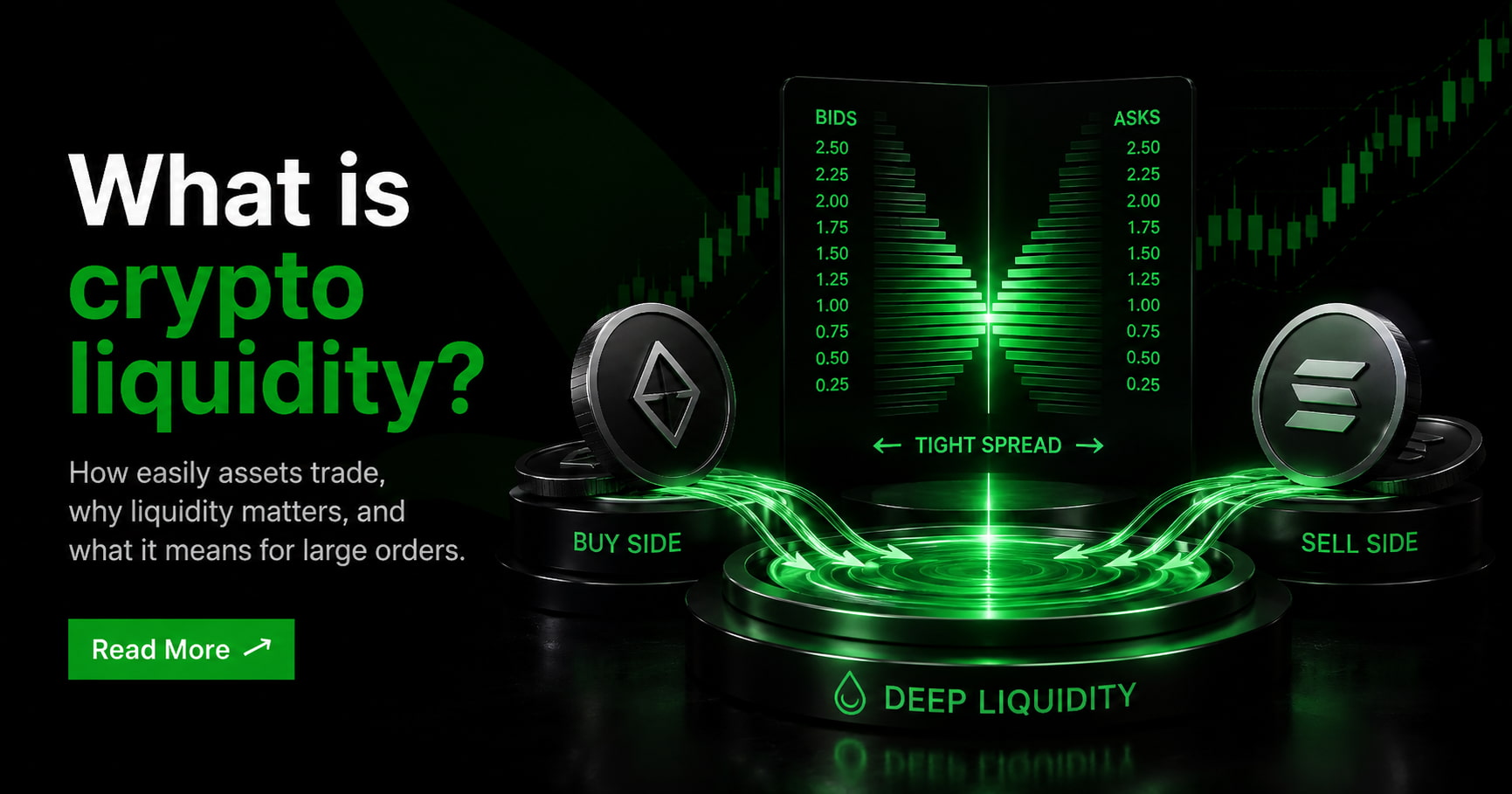
Crypto liquidity is one of those terms that sounds technical but describes something simple: how easily you can buy or sell an asset without moving its price. It quietly shapes every trade you make, from how fast your order fills to the price you actually get. That matters more than most beginners realize, and it matters most of all when the trade is large.
This guide explains what crypto liquidity is, how it is measured, why Bitcoin liquidity is the highest in the market, and why liquidity becomes so important for large trades. It is written in plain language, with no jargon left unexplained.
Liquidity is a measure of how easily an asset can be bought or sold quickly without significantly affecting its price. An asset with high liquidity has plenty of buyers and sellers, so you can trade it fast and close to the price you see quoted. An asset with low liquidity has few participants, so trades take longer and the price can move against you.
In crypto, liquidity varies widely from one coin to the next. Major cryptocurrencies like Bitcoin and Ethereum are highly liquid, with large amounts changing hands daily across many exchanges. Small or new tokens can be thinly traded, which makes them harder to buy or sell without a sharp price change. The table below shows the difference at a glance.
Liquidity does not have a single fixed number, but a few signals give a reliable picture of it.
Trading volume is the total amount of an asset traded over a period, usually 24 hours. Higher volume generally means more activity and more liquidity, since there are more buyers and sellers to trade with. You can check 24-hour volume on data sites like CoinMarketCap or CoinGecko.
The order book lists all the current buy and sell orders at different prices. Depth refers to how many orders sit near the current price. A deep order book, with lots of orders stacked close to the market price, can absorb large trades without the price jumping. A thin book cannot, so even a modest order can move the price.
The bid-ask spread is the gap between the highest price buyers will pay, the bid, and the lowest price sellers will accept, the ask. A narrow spread signals high liquidity and a low cost to trade. A wide spread signals low liquidity, and it means you pay more to buy and receive less when you sell.
Among cryptocurrencies, Bitcoin is widely considered the most liquid. It has the highest trading volume, the deepest order books, and is listed on nearly every exchange, so large amounts can usually be traded quickly and close to the market price. Ethereum, Solana, and major stablecoins like USDT and USDC are also highly liquid.
That said, even Bitcoin's liquidity has limits. Very large orders, the kind placed by so-called whales, can still move its price. Part of the reason is that crypto liquidity is fragmented. Unlike a stock that trades on a single exchange, Bitcoin trades across hundreds of venues, so the liquidity available in any one place is only a slice of the whole. For most everyday trades this is invisible. For large trades, it becomes the main event.
For a small trade, liquidity rarely matters, since there is almost always someone on the other side at roughly the price you expect. For a large trade, it can be the difference between a good execution and an expensive one. Here is why.
Slippage is the gap between the price you expected and the price you actually got. Imagine trying to sell one million dollars of Bitcoin when only five hundred thousand dollars of buy orders sit near the current price. Your order fills the nearby orders first, then reaches lower ones, so the average price you receive ends up below the quoted price. The larger your order is relative to the available liquidity, the worse the slippage.
A large order does not just suffer slippage; it can move the market itself. A big sell order pushes the price down as it consumes buy orders, and a big buy order pushes it up. This market impact can work against you, and in a thin market it can be severe. Splitting an order into smaller pieces can help, but it takes time and does not remove the problem.
This is why large trades are often handled over the counter, or OTC, rather than on a public exchange. In an OTC trade you deal directly with a counterparty or broker at an agreed price, which avoids eating through an order book and moving the market. UpTrade offers OTC trading with access to deep liquidity, so larger orders can be filled at a single agreed price with same-day settlement. You can book a consultation to talk through a large trade.
Several things influence how liquid a given cryptocurrency is at any moment.
Well-established, widely held coins tend to be far more liquid than new or obscure ones. The more people buy, sell, and use an asset, the more liquid it becomes, which is why the largest cryptocurrencies stay the easiest to trade.
Liquidity differs by platform. Large exchanges with many users tend to have deeper markets, while smaller venues can be thin. Decentralized exchanges provide liquidity through pools rather than order books, which behave differently again. Our guide to digital asset trading covers how these venues compare.
Sentiment, news, and volatility all move liquidity around. Calm markets tend to be deep and steady, while during sharp moves liquidity can thin out just when it is needed most. Gauges like the crypto fear and greed index can hint at the mood driving those shifts.
Low liquidity is not just an inconvenience; it carries real risks. In a thin market, you may struggle to exit a position at a fair price, or at all, especially during a sell-off when everyone heads for the door at once. Slippage eats into returns on every trade.
Illiquid tokens are also easier to manipulate, since a relatively small amount of money can swing the price, which is a common feature of pump-and-dump schemes. For these reasons, many traders weigh liquidity carefully before buying a smaller asset. This is general information, not financial advice.
Liquidity in crypto is how easily you can buy or sell a coin quickly without moving its price much. When liquidity is high, there are lots of buyers and sellers, so trades happen fast and at close to the expected price. When it is low, there are few participants, so trades are slower and the price can shift against you.
Bitcoin has the highest trading volume in crypto, the deepest order books, and is listed on almost every exchange, so there are always buyers and sellers ready to trade. That depth means large amounts can usually be bought or sold quickly and close to the market price, which is what makes Bitcoin liquidity the strongest in the market, even if very large orders can still move it.
The main signals are trading volume, order book depth, and the bid-ask spread. High 24-hour volume, plenty of orders stacked near the current price, and a narrow spread all point to high liquidity. Low volume, a thin order book, and a wide spread point to low liquidity. Data sites like CoinMarketCap and CoinGecko show volume and spreads.
Slippage is the difference between the price you expected for a trade and the price you actually got. It happens when there are not enough orders at your desired price, so the trade fills at progressively worse prices. Slippage is usually small in liquid markets like Bitcoin and larger in thin markets or on very big orders.
Large trades can exhaust the orders near the current price, causing slippage and moving the market against you. In a thin market this can be costly. That is why large trades are often done over the counter, where you agree a single price with a broker or counterparty rather than pushing a big order through a public order book. This is general information, not advice.
General information only. This article is for educational purposes and does not constitute financial, investment, legal or tax advice, nor a recommendation to buy, sell or hold any asset. Cryptocurrency is a high-risk asset and you should consider your own circumstances and seek independent advice before making any decision. UpTrade does not make price predictions.

Market updates, new explainers and the occasional Alpha Pro report, sent once a week. Unsubscribe anytime.