Cold storage keeps your crypto's private keys completely offline, out of reach of hackers. Here's how it works and when it's worth it.
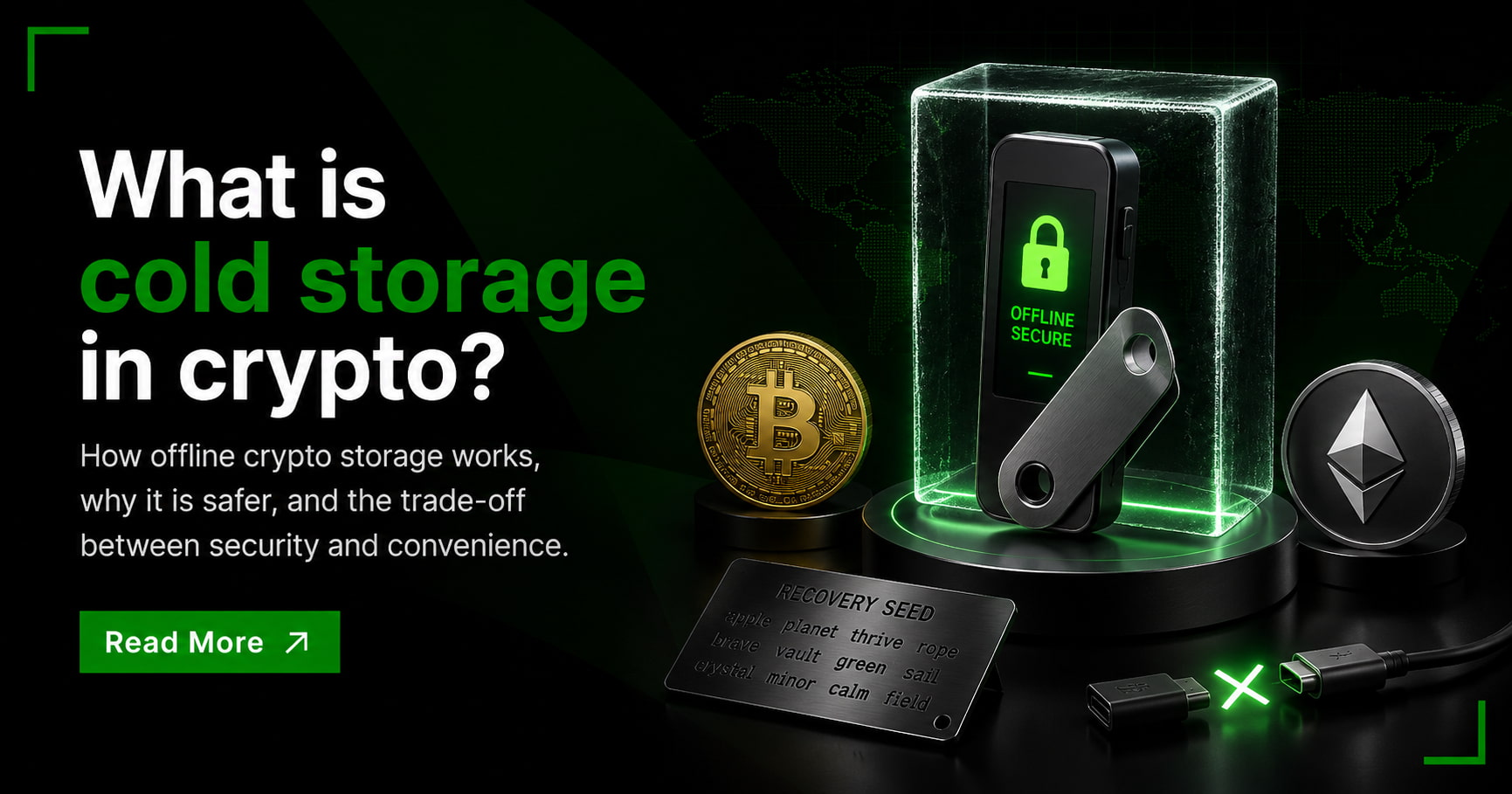
If you have spent any time around crypto security, you have probably heard that serious holders keep their coins in cold storage. So what is cold storage in crypto, and do you actually need it? In short, cold storage means keeping the private keys that control your crypto completely offline, where hackers cannot reach them. It is widely seen as one of the safest ways to protect digital assets.
This guide explains what cold storage is, how it works, the different types, how it compares to a hot wallet, and when it makes sense to use one. It is written for people new to the idea, with the trade-offs laid out honestly.
Cold storage is a way to keep the keys to your cryptocurrency completely offline, disconnected from the internet, and out of reach of remote attackers. Because cold storage never touches the internet, it is widely regarded as one of the safest ways to hold digital assets for the long term.
There is an important detail hidden in that description. Cold storage does not move your coins anywhere. Your crypto always lives on the blockchain, and it never leaves it. What a wallet actually holds is the private key, a secret code that proves the coins are yours and lets you move them. Put your crypto in cold storage, and you are moving that key offline, not the coins themselves. Since the key is what a thief would need, keeping it offline is what keeps the crypto safe.
So how does keeping a key offline work in practice? The key is created and stored on a device that never connects to the internet. To receive crypto, you do not even need to touch the device. You share your public address, and the funds arrive on the blockchain as normal.
Sending is where the offline part matters. When you want to move funds, the transaction is prepared on a connected device, then handed to the offline wallet to be signed with your private key. Only the signed result is sent back online for broadcast, and the key itself never leaves the offline device. Most hardware wallets also ask for a PIN and a physical button press, so even someone holding the device cannot move your funds without your approval.
Cold storage comes in a few forms, though one is far more common than the rest.
A hardware wallet is a small physical device, a little like a USB stick, built specifically to store keys offline and sign transactions. Ledger and Trezor are two well-known makers. This is the most popular form of cold storage by a wide margin, striking a balance between strong security and ease of use.
A paper wallet is a printout of your keys or recovery phrase, often as a QR code. Paper wallets were common in crypto's early days but are rarely recommended now, since paper is easy to lose, damage, or read by the wrong person.
A metal wallet is a plate stamped or engraved with your recovery phrase, made to survive fire, water, and time. It is used mainly as a durable backup of a phrase rather than a device you interact with day-to-day.
An air-gapped computer is an ordinary machine kept permanently offline and used only to manage keys. It is an approach favored by the very security-conscious, and it takes more effort to set up and use safely.
The counterpart to cold storage is the hot wallet, and the two suit very different needs. A hot wallet is software that stays connected to the internet, such as an exchange account, a mobile app, or a browser extension. That connection makes it quick and easy to use, which is the same reason it is more exposed to online threats.
A useful way to picture the two is a checking account next to a savings account. Your hot wallet is the checking account, handy for everyday spending and the amounts you are actively using. Cold storage is the savings account, better suited to money you plan to hold for a long time. Plenty of people use both. The table below lays out the main differences.
Cold storage is powerful, but it is not effortless. It is worth weighing both sides before you start.
Because the keys never go online, they are effectively out of reach of remote hackers, which makes cold storage well suited to long-term holdings and larger amounts. It also keeps your assets separate from any exchange, so a platform being hacked or collapsing does not put your coins at risk. And you keep full control, without trusting anyone else to hold your keys.
That control comes with real responsibility. Hardware wallets cost money upfront, there is a learning curve to setting them up, and spending takes more steps than tapping an app. Most importantly, if you lose the device and your backup, or forget your PIN with no recovery phrase saved, the funds can be gone for good, with no support line to call. Cold storage is very secure, but it is not foolproof, and the weakest point is usually simple human error.
If you do use cold storage, a few habits make a real difference to how safe your crypto stays.
Managing cold storage yourself is not the only path, and it is not the right fit for everyone. The alternative is to use a custodian, a regulated provider that holds your assets in professional, offline storage on your behalf, usually with insurance and strict access controls. This takes away the burden of guarding your own hardware and recovery phrase, in exchange for relying on that provider rather than holding the keys yourself.
This is the model UpTrade uses. Client assets can be held in institutional-grade custody through Fireblocks, the same infrastructure trusted by major financial institutions, at no extra cost. You can read more on our custody page. Which approach suits you depends on how much you hold, how hands-on you want to be, and how you weigh control against convenience. Neither is automatically better, and this is not financial advice.
Cold storage means keeping the private keys that control your crypto completely offline, so online hackers cannot reach them. Your coins stay on the blockchain, but the key that unlocks them is stored on a device or medium that never connects to the internet. It is one of the most secure ways to hold crypto, especially for the long term.
For online threats, yes. Because the keys never go online, cold storage is not exposed to remote hacking, phishing, or malware the way a hot wallet is. It has its own risks, though, mainly physical ones: losing the device or backup, or damaging it. The safest approach for many people is a mix, keeping small amounts in a hot wallet and larger, long-term holdings in cold storage.
Losing the device itself does not have to mean losing your crypto, as long as you have your recovery phrase backed up safely. That phrase lets you restore your keys onto a new device. The real danger is losing both the device and the recovery phrase, or never backing the phrase up in the first place, in which case the funds usually cannot be recovered.
Not necessarily. For small amounts you use often, a hot wallet is usually convenient enough, and the extra steps of cold storage may not be worth it. Cold storage tends to make more sense as your holdings grow or as you hold for the long term. A common rule of thumb is that if an amount would worry you to lose, it may be worth moving offline. This is general guidance, not financial advice.
Yes, in effect. Rather than buying and managing your own hardware, you can use a custodian that holds assets in professional cold storage for you. This is what UpTrade offers through institutional-grade custody, so you get the security of offline storage without managing a device or recovery phrase yourself. The trade-off is that the provider holds the keys rather than you.
General information only. This article is for educational purposes and does not constitute financial, investment, legal or tax advice, nor a recommendation to buy, sell or hold any asset. Cryptocurrency is a high-risk asset and you should consider your own circumstances and seek independent advice before making any decision. UpTrade does not make price predictions.

Market updates, new explainers and the occasional Alpha Pro report, sent once a week. Unsubscribe anytime.