XRPL is the blockchain, XRP is the token that runs on it. Here's the difference, and where Ripple actually fits in.
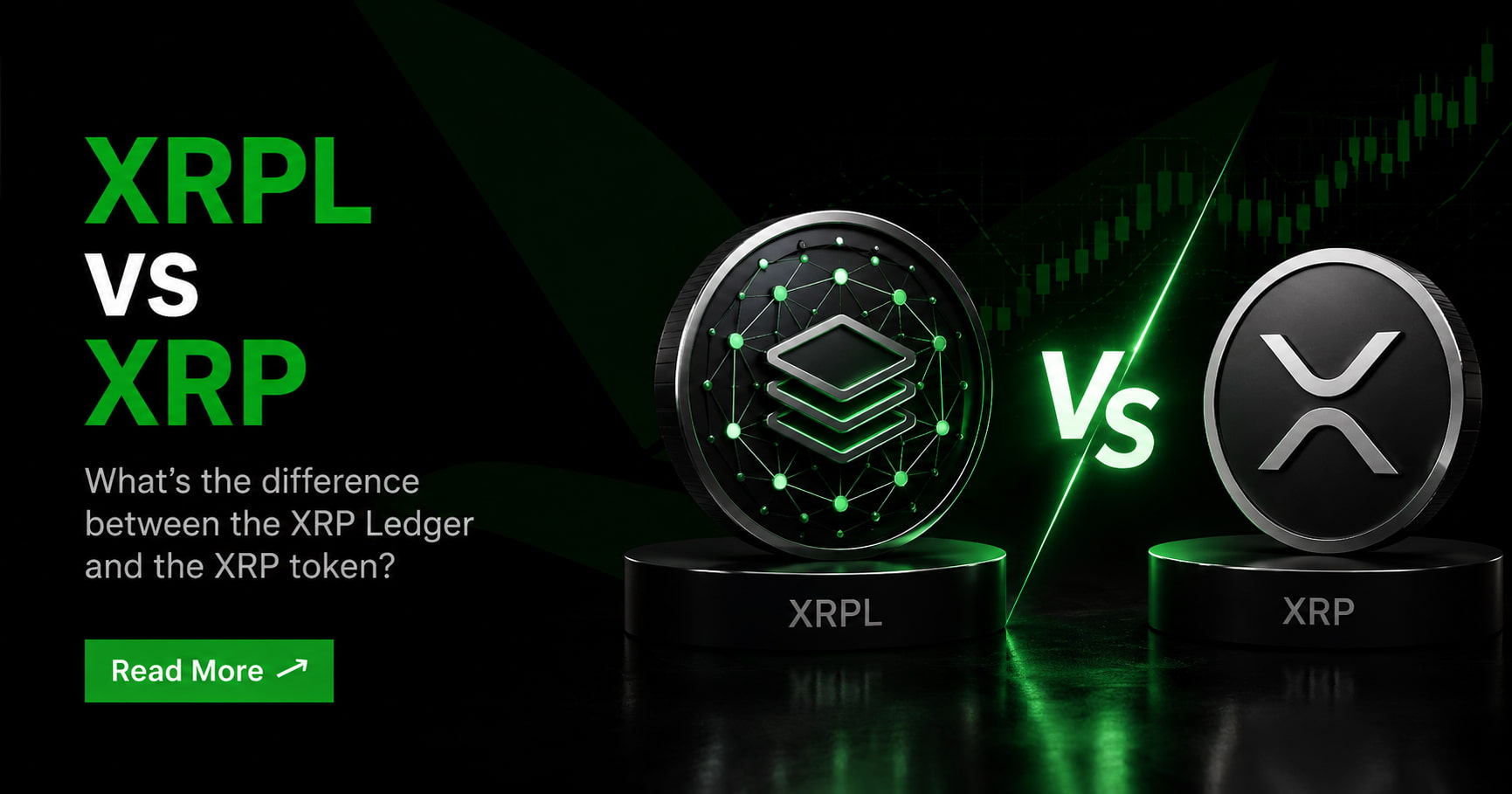
XRPL vs XRP is one of the most common points of confusion in crypto, and it is easy to see why. The two names look almost identical, and people often use them as if they mean the same thing. They do not. XRPL is the XRP Ledger, a blockchain, while XRP is the cryptocurrency that runs on it. One is the network, the other is the token.
This guide clears up the difference in plain language: what the XRP Ledger is, what XRP is, how the two work together, and where the company Ripple fits in. By the end, the distinction will be simple to keep straight.
The confusion is understandable, but the difference is simple once you see it. XRPL stands for the XRP Ledger, and it is a blockchain: the underlying network that records and settles transactions. XRP is the cryptocurrency that lives on that network. One is the system, the other is the money that moves through it.
A common way to picture it is a road and the traffic on it. The XRP Ledger is the highway, built for value to move quickly and cheaply. XRP is both the vehicle carrying that value and the small toll paid to use the road. They are designed to work together, but they are not the same thing.
The XRP Ledger is an open-source, decentralized blockchain that launched in 2012, built to move money across the world in seconds at very low cost. It is a Layer-1 network, meaning a base blockchain in its own right rather than something built on top of another chain. A few features set it apart.
Instead of the mining used by Bitcoin or the staking used by Ethereum, the XRP Ledger relies on a network of trusted validators that reach agreement every few seconds. That makes it energy-efficient, with no mining involved. Our guide to Bitcoin and Ethereum explains those other approaches.
Transactions on the XRP Ledger settle in three to five seconds and cost a tiny fraction of a cent. That speed and low cost are a big part of why the ledger was designed for payments rather than heavy computation.
The ledger does more than move XRP. It has a built-in exchange for trading assets directly on the network, and it can host other tokens, including stablecoins and tokenized real-world assets. In short, it is a piece of financial infrastructure, not just a home for a single coin.
The XRP Ledger is public and permissionless, so anyone can run a node, submit transactions, or build applications on it without asking permission. That openness, maintained by validators around the world, is what keeps it decentralized rather than controlled by any single company. Our guide to permissionless blockchains explains the idea in more depth.
XRP is the native cryptocurrency of the XRP Ledger, which means it is the token the network was built around. It has a specific job in keeping the network running, on top of being an asset people trade.
Unlike Bitcoin, XRP was not mined over time. All 100 billion XRP were created at once when the ledger launched, and they are released into circulation gradually, with a large portion held in reserve. The total supply is fixed, so no new XRP can be created. Our guide to tokenomics covers how a token's supply is designed.
XRP has a few specific jobs. Every transaction burns a tiny amount of XRP as a fee, which helps keep the network from being flooded with spam. Activating a wallet requires holding a small reserve of XRP. And because XRP can be swapped quickly for other assets, it often acts as a bridge between currencies on the ledger's exchange.
Beyond its role on the network, XRP is also a widely traded asset in its own right, and one of the more liquid cryptocurrencies on the market. For the practical steps of acquiring it, see our how to buy XRP page.
XRP and the XRP Ledger are closely linked by design. XRP cannot exist without the ledger, since it is native to it, and the ledger depends on XRP for the fees and reserves that keep it running. The ledger can carry many different assets, but XRP is built into its core in a way no other token is. The table below sums up the difference at a glance.
No. XRPL is the XRP Ledger, a blockchain, while XRP is the cryptocurrency that runs on it. One is the network and the other is the token that moves across it. They are closely connected, since XRP is built into how the ledger works, but they are two different things.
XRPL stands for the XRP Ledger. It is the open-source, decentralized blockchain that launched in 2012 and processes XRP transactions. As well as moving XRP, it supports a built-in exchange, token issuance, and tokenized assets, which makes it a broader piece of financial infrastructure than a single coin.
No. XRP is native to the XRP Ledger, so it only exists on that network. XRP is also essential to the ledger in return, since it pays transaction fees and provides the reserves that protect the network from spam. The two are built to depend on each other.
No. XRP is the cryptocurrency, and Ripple is a private company that builds payment software using XRP and the XRP Ledger. People often use the names interchangeably, but XRP is a digital asset on a decentralized network, while Ripple is a business. XRP is not shares in Ripple, and Ripple does not own the ledger.
No. The XRP Ledger can host many assets, including stablecoins and tokenized real-world assets, and it has a built-in exchange for trading them. XRP holds a special place, though, because it is hardcoded into the network to pay fees and guard against spam, which no other token on the ledger does.
General information only. This article is for educational purposes and does not constitute financial, investment, legal or tax advice, nor a recommendation to buy, sell or hold any asset. Cryptocurrency is a high-risk asset and you should consider your own circumstances and seek independent advice before making any decision. UpTrade does not make price predictions.

Market updates, new explainers and the occasional Alpha Pro report, sent once a week. Unsubscribe anytime.